About PhD Program in Science and Policy
The PhD Program in Science and Policy complements a doctoral research project, may it be in life, environmental, earth, agricultural, engineering, energy or food sciences with a structured and specialized training. It bridges the gap between science-based discovery and societal impact by equipping doctoral candidates with the specific competencies needed to navigate the science-policy interface. These competencies extend beyond their individual research projects and contribute to a well-rounded professional profile.
What is a structured PhD Program?
A structured PhD program complements the individual doctoral research project with an organized framework of training, skill development, and academic exchange. While doctoral research provides highly specialized scientific expertise through the development of an independent doctoral research project and the completion of a doctoral thesis, many doctoral candidates also consider a variety of future career paths both within and beyond academia. Complementing thesis work with broader training can therefore be an important part of preparing for future career steps.
By joining the PhD Program in Science and Policy, doctoral candidates become part of a structured doctoral training environment that complements the supervision and research conducted in their host research group. The PhD program offers a curriculum designed to support the development of competencies required for conducting independent research and for pursuing a wide range of career paths.
Training in the PhD Program in Science and Policy
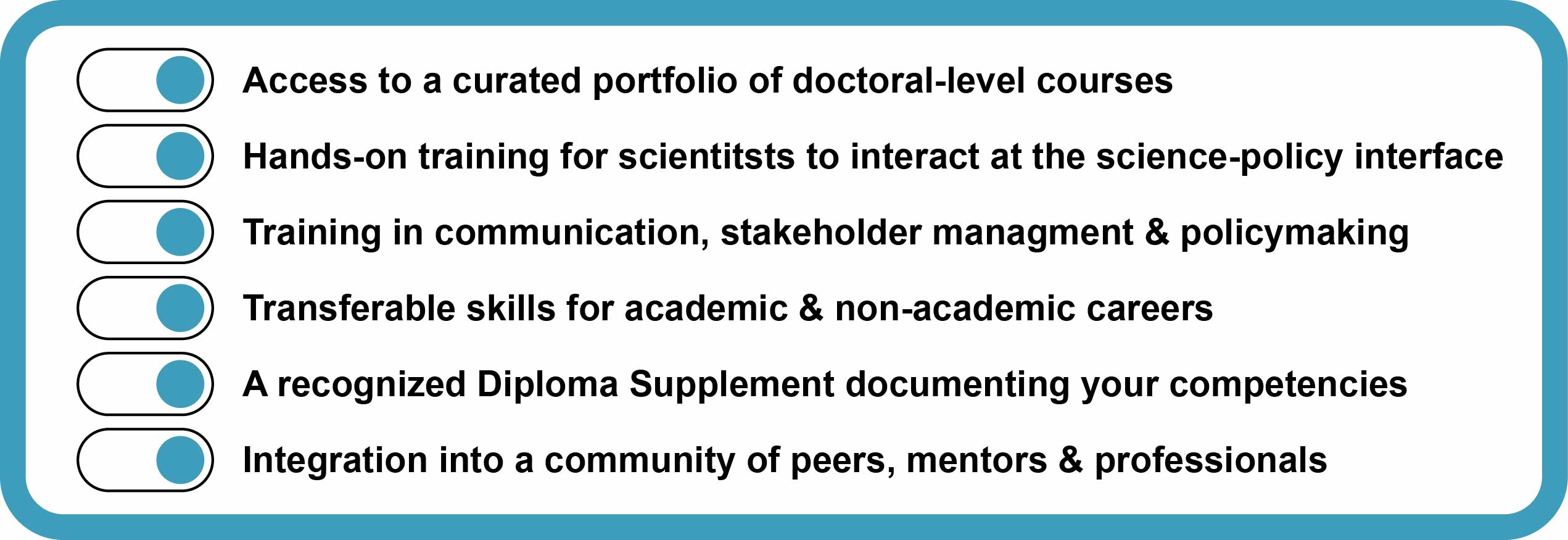
The PhD Program in Science and Policy provides access to a specialized curriculum designed to bridge the gap between scientific research and evidence-based policymaking. Complementing doctoral research, participants engage in a curated portfolio of workshops that introduce the theories, tools, and methods necessary for effective science-policy dialogue. Particular attention is given to the development of core competencies relevant to evidence-based policymaking, stakeholder engagement, risk assessment, and the communication of scientific results to politicians, practitioners and the public.
In addition to regular workshops, the PhD program offers intensive training formats, including thematic summer schools. These events bring together international experts, policymakers, and doctoral researchers to explore timely case studies and emerging challenges at the science-policy interface in greater depth. Through a combination of lectures, group work, and exchange with practitioners, participants have the opportunity to deepen their understanding of political processes while gaining practical experience in translating complex scientific findings into actionable policy advice.
Beyond policy-specific training, the program supports the development of transferable skills essential for professional success in government, NGOs, industry, and academia. These include strategic foresight, scenario building, systems thinking, and research integrity. By integrating these skill sets, the PhD program empowers doctoral candidates to not only conduct impactful research but also to navigate the societal and political dimensions of their work, preparing them for leadership roles in a rapidly changing global landscape.
Our PhD program learning objectives are:
- Learn about the policymaking process and the ways to engage with evidence-based research.
- Learn how to translate research findings for policy-relevance.
- Improve your communication of scientific results with policymakers, media and the public.
- Learn to involve different stakeholder groups in a participatory process.
- Build competencies and skills for your transition into a science-policy career.
- Build a science and policy network.
Doctoral researchers in the PhD program will obtain their doctoral degree (in Science) from ETH Zurich (ETHZ), University of Zurich (UZH) or University of Basel (UNIBAS), supplemented by the PhD program certificate.
Other benefits of joining the PhD program
Community and networking - The PhD Program in Science and Policy connects doctoral candidates with the extensive network of the Zurich-Basel Plant Science Center, the Energy Science Center, the World Food System Center, integrating researchers and mentors of all career stages from ETH Zurich, the University of Zurich, and the University of Basel. By participating in program-specific activities—such as science and policy workshops, science and policy talks, and stakeholder events—doctoral candidates engage in a continuous exchange with senior scientists, policy practitioners, as well as national and international experts. These interactions allow them to situate their research within a broader societal context and build a professional network that spans the boundary between science and administration.
Career development - The training program is specifically designed to cultivate a robust set of transferable skills and policy competencies essential for impactful careers of researchers in government, NGOs, international organizations, and academia. As funding bodies and global employers increasingly value researchers who can navigate the "science-to-action" pipeline, completion of this structured program ensures that graduates are uniquely positioned to translate complex scientific data into evidence-based solutions for society.
Eligibility
The PhD Program in Science and Policy is open to doctoral students officially enrolled at the University of Zurich (UZH), ETH Zurich (ETHZ), or the University of Basel (UNIBAS).
Please note that the PhD program itself provides specialized training to supplement your doctoral research (i.e., independant of your thesis topic); it does not offer or fund PhD positions. To be eligible for enrollment, prospective students must fulfill one of the following two options:
-
Option 1: Secure a PhD position directly within a research team at one of the three partner universities (UZH, ETHZ, or UNIBAS) under the supervision of a affiliated professor.
-
Option 2: Secure a PhD position within a research team at a Swiss research institution (such as Agroscope, Eawag, WSL, Empa, PSI, etc.) that is formally affiliated with and allows for enrollment at one of the three partner universities.
In both cases, your first step is to find a professor who will act as your primary PhD thesis supervisor.
Once you have secured your PhD position, if you fulfil above condions you are ready to join PhD Program in Science and Policy!